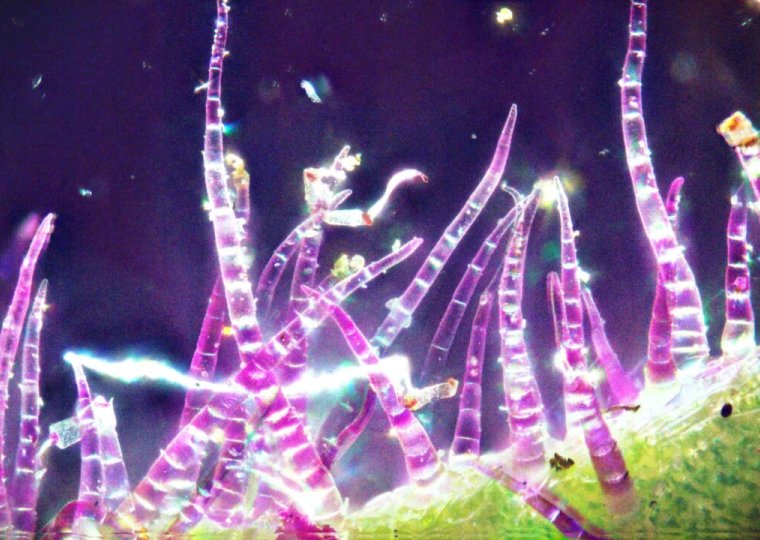
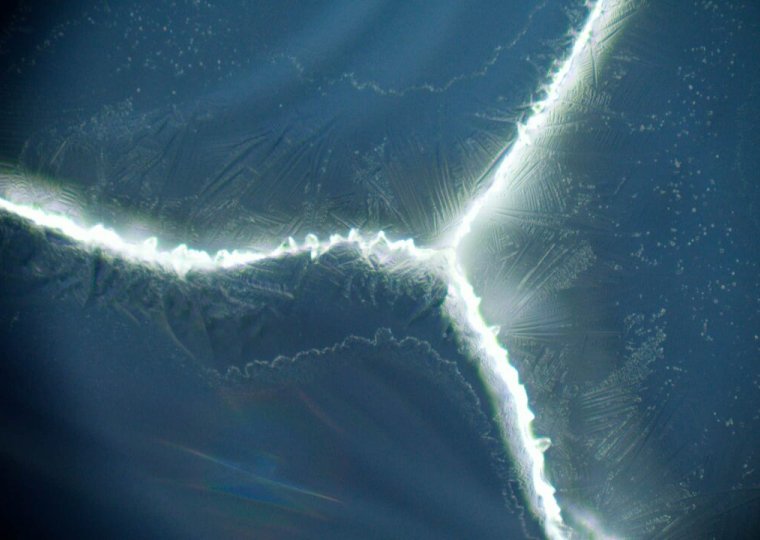
Sometimes the physics behind two droplets coming together deserves a film of its own. In this video, rather than simply explaining emulsion theory, we examine the structure visually and capture the much-discussed optical marker: Maltese crosses.
The opening shots show two coverslips. One holds an aqueous phase, the other an oily lipid phase. As we bring them together on a slide, the phases begin flowing into one another. We record the process in time-lapse at 6000× digital magnification, without a reducer. Producing a fully stable emulsion in this live-view arrangement is extremely difficult: it requires conditions that cannot easily be maintained while observing the specimen. The footage shows a depleted aqueous solution moving under pressure through the oily phase, not a finished product.
Around the first minute, we show a properly prepared lamellar emulsion. This is not a spontaneous mixture but an organized system of multilayer lipid sheets. Polarized illumination reveals anisotropy: birefringence produces the characteristic Maltese crosses, seen as dark wedges against a luminous background. It looks striking, but visual beauty alone is not enough.
A classic check is to rotate the specimen through 360 degrees and observe the cross. Here, we take a more direct route and add a drop of acetone. The lipid framework breaks down and the crosses disappear. Without the organized lipid structure, the birefringence disappears too. This demonstrates the relationship between the observed patterns and the lamellar structure. Cryogenic freeze-fracture electron microscopy would be another, more involved approach.
The truth behind the “miracle product”
These emulsions are marketed as a “second skin”, an “innovative emulsifier-free structure”, an imitation of the skin's lipid barrier or a universal next-generation treatment.
The basis for such language is the liquid-crystalline organization and optical texture of a lamellar emulsion. Its layered form can resemble the lipids of the skin's stratum corneum and creates a continuous oil-and-water layer. The source article connects this organization with moisturizing, compatibility and protective-barrier functions.
Let us separate the technology from the marketing.
From a colloid-chemistry perspective, a lamellar emulsion is a particular form of oil-in-water emulsion. Emulsifiers stabilize its structure — despite claims that lamellar systems contain none. Early lamellar emulsions relied on lecithin derivatives, so phospholipids should not be treated as a surprising ingredient.
The structure is more complex than a simple mixture. Oil-soluble substances are organized within a system containing water-soluble substances. This useful arrangement occupies a delicate equilibrium and is highly sensitive to composition, concentration and processing.
The lamellar layer may be gel-like or liquid-crystalline, and there are many ways to create it. Individual lamellar structures can also occur in ordinary emulsions. A fully lamellar structure throughout a product is less common and requires:
- Appropriate emulsifiers: These may be lecithin-based, peptide, carbohydrate, lipid or mixed systems.
- Precise processing: Temperature, pressure, speed, timing and other conditions must be controlled.
Even when a formula is correct, a single processing deviation can prevent lyotropic liquid crystals from forming. The product may be only partially lamellar rather than uniformly structured, falling short of the intended performance.
Emulsifiers and structural components
Cholesterol esters can act as structural components and stabilizers. Specific emulsifiers are also required, but their presence alone does not guarantee a layered structure.
The list of relevant ingredients continues to grow. Without suitable structural ingredients, however, a mixture cannot form the intended architecture.
| Phospholipids | Lipids | Sugars | Amino acids |
|---|---|---|---|
| Lysofix™ | |||
| Heliosoft™ — a derivative of phospholipids and alcohols | |||
| Hydrogenated Lecithin | Cetearyl Olivate (and) Sorbitan Olivate — Olivem 1000, B&T | Sodium Stearoyl Glutamate — a derivative of sugars and amino acids | Sodium Stearoyl Glutamate — a derivative of sugars and amino acids |
| Hydrogenated Lecithin (and) C12-16 Alcohols (and) Palmitic Acid — Biophilic H, Lucas Meyer | Sucrose Polystearate (and) Cetyl Palmitate — Emulgade Sucro Plus, BASF | Potassium Cetyl Phosphate (and) Behenyl Alcohol — Pair2Phase1, Schill+Seilacher | |
| Lecithin (and) C12-16 Alcohols (and) Palmitic Acid — Biophilic S, Lucas Meyer | Cetearyl Glucoside (and) Cetearyl Alcohol — Emulgade PL 68/50, BASF; Montanov 68 MB, Seppic; lipid/sugar derivatives | Cetearyl Glucoside (and) Cetearyl Alcohol — Emulgade PL 68/50, BASF; Montanov 68 MB, Seppic; lipid/sugar derivatives | |
| Behenyl Alcohol (and) Glyceryl Stearate (and) Lecithin (and) Glycine Soja Sterols — Amisol Soft, Lucas Meyer | Sucrose Polystearate (and) Cetearyl Alcohol (and) Olea Europaea Oil Unsaponifiables — Plantasens Natural Emulsifier HP10, Clariant; lipid/sugar derivative | Sucrose Polystearate (and) Cetearyl Alcohol (and) Olea Europaea Oil Unsaponifiables — Plantasens Natural Emulsifier HP10, Clariant; lipid/sugar derivative | |
| Aqua (and) Caprylic/Capric Triglyceride (and) Butyrospermum Parkii Butter (and) Hydrogenated Phosphatidylcholine (and) Glycerin (and) Phytosterols (and) Glyceryl Caprylate (and) Ceramide NP — Cellike, Clariant | Cetearyl Glucoside (and) Sorbitan Olivate — Plantasens Natural Emulsifier HE20, Clariant and other manufacturers; lipid/sugar derivative | Cetearyl Glucoside (and) Sorbitan Olivate — Plantasens Natural Emulsifier HE20, Clariant and other manufacturers; lipid/sugar derivative | |
| Glyceryl Stearate (and) Behenyl Alcohol (and) Palmitic Acid (and) Stearic Acid (and) Lecithin (and) Lauryl Alcohol (and) Myristyl Alcohol (and) Cetyl Alcohol — Prolipid 141, Ashland | Cetearyl Glucoside (and) Sorbitan Stearate (and) Glyceryl Stearate (and) Cetearyl Alcohol — Emulpharma Coreosome, Res Pharma; lipid/sugar derivative | Cetearyl Glucoside (and) Sorbitan Stearate (and) Glyceryl Stearate (and) Cetearyl Alcohol — Emulpharma Coreosome, Res Pharma; lipid/sugar derivative | |
| Potassium Cetyl Phosphate (and) Oryza Sativa Bran Cera — Pair2Phase2, Schill+Seilacher | C14-22 Alcohols (and) C12-20 Alkyl Glucoside — Montanov L, Seppic | ||
| Potassium Olivoyl Hydrolyzed Wheat Protein (and) Cetearyl Alcohol (and) Glyceryl Oleate (and) Glyceryl Stearate — Olivoil Emulsifier, Kalichem; lipid/peptide derivative | |||
| Cetearyl Alcohol (and) Glyceryl Stearate (and) Sodium Olivoyl Glutamate (and) Aqua — Olivoil Glutamate Emulsifier, Kalichem; lipid/peptide derivative |
This classification is approximate: many emulsifiers combine more than one class.
What else matters?
The formula and manufacturing procedure must be followed accurately at every stage. A lipid bilayer forms through phospholipid self-assembly in an aqueous environment. Phase transitions therefore depend on:
- Concentration.
- Temperature.
- Speed.
- Pressure.
- Time.
- Ionic strength.
Lamellar phases may transform into other self-assembled structures:
- Hexagonal phase (H₁): At reduced water content, cylindrical micelles form a two-dimensional lattice.
- Cubic phases (Q): Form at particular balances between the hydrophilic and hydrophobic portions of an amphiphile.
- Isotropic solution: Can form when strong dilution disrupts layered order.
Shear-induced transitions are especially interesting: mechanical deformation changes the lamellar arrangement and can produce multilayer vesicles.
Possible defects include layer dislocations that interrupt order, disclinations and bending defects similar to those in liquid crystals, and multilamellar vesicles formed as layers reorganize.
Examining the finished emulsion
The source article emphasizes microscopy as a way to demonstrate structure: place a drop on a slide and observe it against a dark background under polarized illumination.
Crossed polarizers reveal whether anisotropy is present. The interference pattern can show Maltese crosses, but the investigation should examine more than their mere presence: their number and distribution, together with the emulsion's appearance in ordinary light, also matter.
A well-developed lamellar structure can produce crosses distributed throughout the observed volume, like a star-filled sky.
Similar optical effects can arise from other crystalline forms. Individual crosses around large oil droplets, without comparable patterns elsewhere, should not be mistaken for a uniformly lamellar product. They may indicate an early attempt at crystallization or a mixture of lamellar, liquid-crystalline and hexagonal structures.
The conclusion: Examine the actual structure in detail. Our chemists and microbiologists can help.
What we do
We help in two important areas:
- High-quality content that communicates your advantages.
- Stronger internal quality control for every product batch.
Training and equipment upgrades
We train your team to use your existing microscopy and imaging equipment, audit it and recommend upgrades for specific quality-control tasks. Your employees can then create high-resolution photo and video content for presentations and films.
Full-cycle content production
We can produce your advertising materials, film and edit evidence-based video, and capture high-resolution macro photographs and footage. Our work combines scientific authenticity with visual expression.
Mobile laboratories and events
For an effective demonstration of your product, we bring microscopes and the necessary equipment, configure large-screen displays and provide full expert support. This is suited to exhibitions, press conferences and private presentations.
Additional service
We help select and purchase microscopes and research systems with plan-achromatic or apochromatic correction for fluorescence, polarization, phase contrast or differential interference contrast, in line with your project brief.