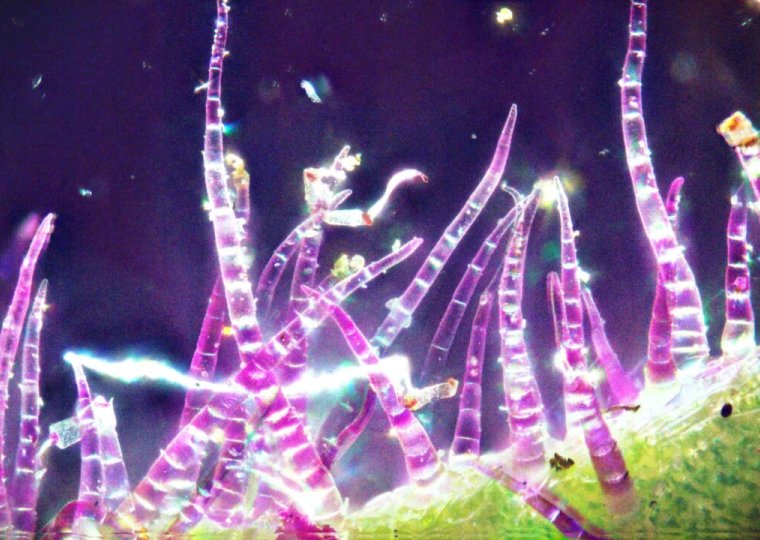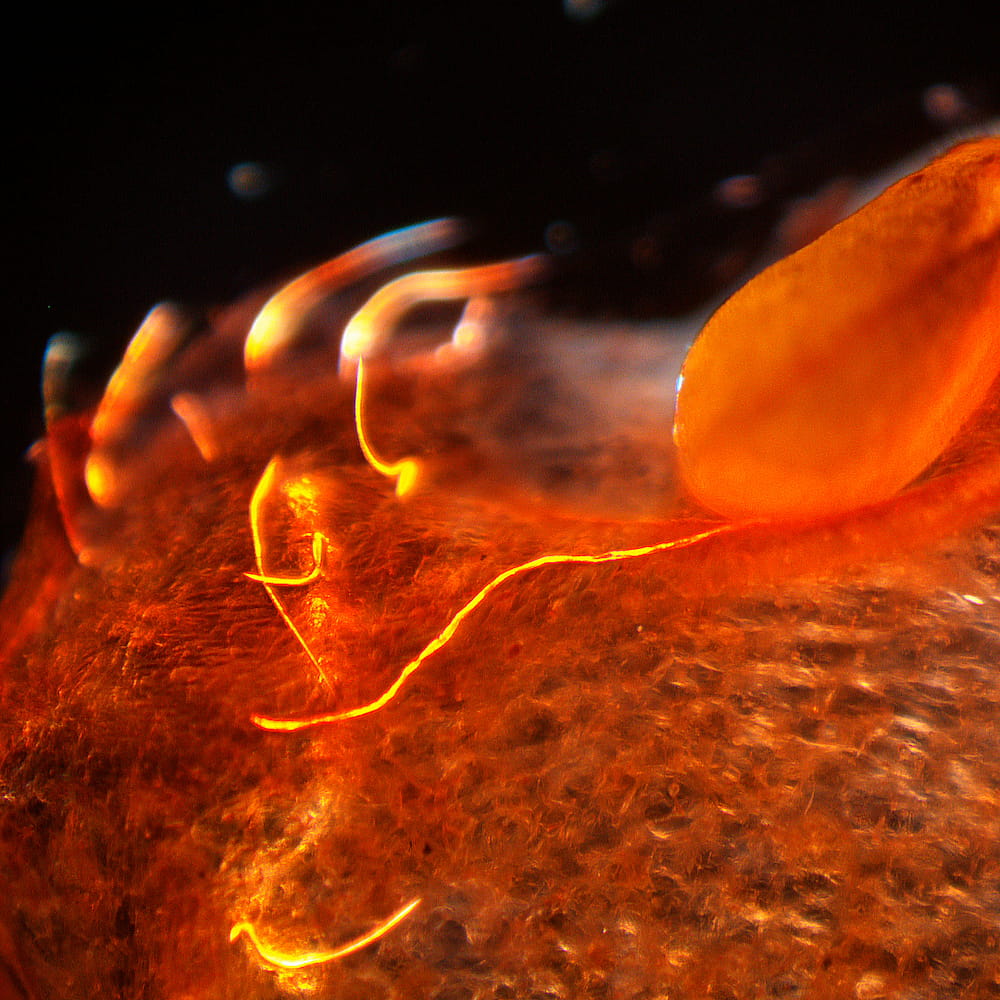
Polarization microscopy reveals certain material properties that are not visible during ordinary microscopic examination. Here are some key aspects of plants viewed in polarized light.
1. Crystals and structures
Some fruits contain crystalline structures, such as sugar crystals — for example sucrose in melon or pineapple. These crystals can display different colors and patterns in polarized light.
2. Cell walls
Plant cell walls contain cellulose and may show different optical properties under polarization. This helps study their composition and structure.
3. Pigments
Some fruit pigments appear differently in polarized light. For example, anthocyanins in berries may look different depending on the angle and intensity of illumination.
4. Fibres
Fruits such as coconuts and bananas have a fibrous structure. Polarization can help reveal these fibres and their organization.
5. Studying microorganisms
Polarization microscopy can be used to investigate microbial communities on fruit surfaces, since certain microorganisms may exhibit particular optical properties.
Examples of applications
- Crystals: When viewing a piece of fruit through a polarization microscope, you can observe different colors and structures as you rotate the specimen.
- Comparative studies: Compare the optical properties of different fruit varieties.